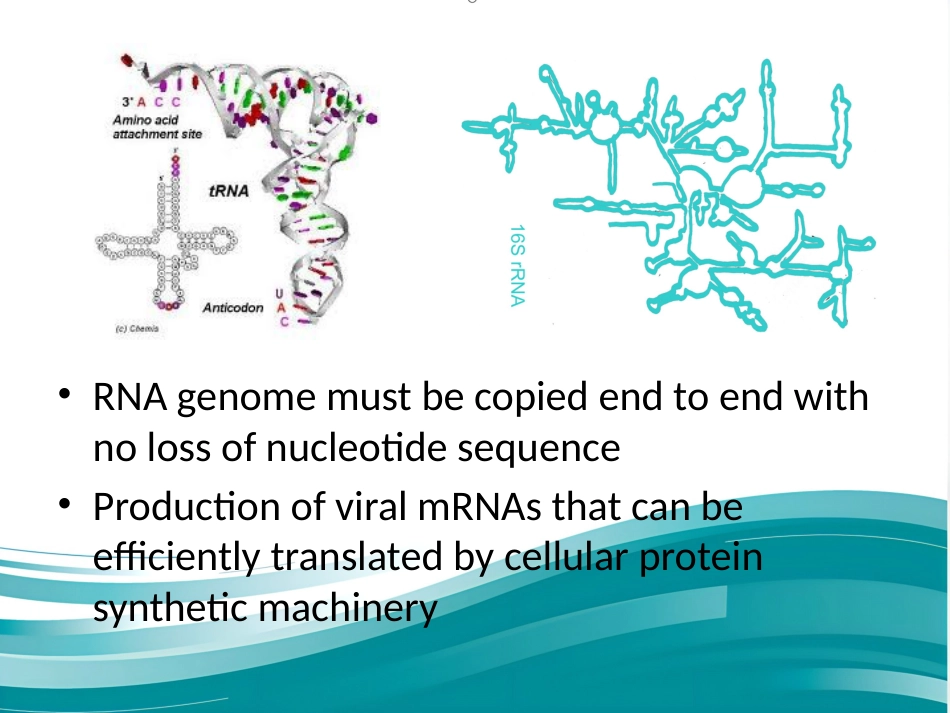
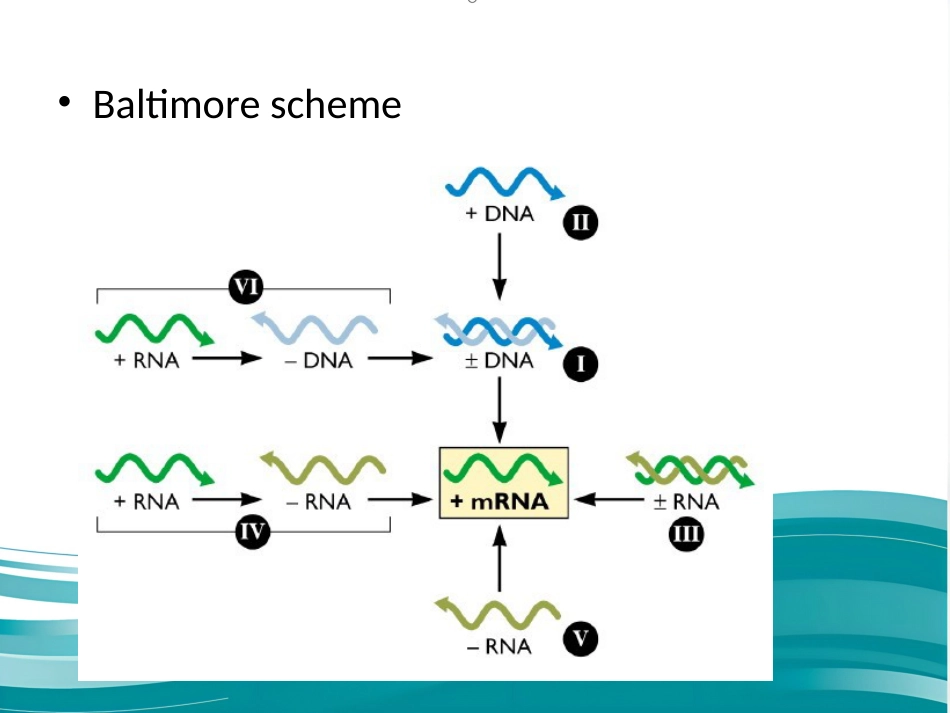
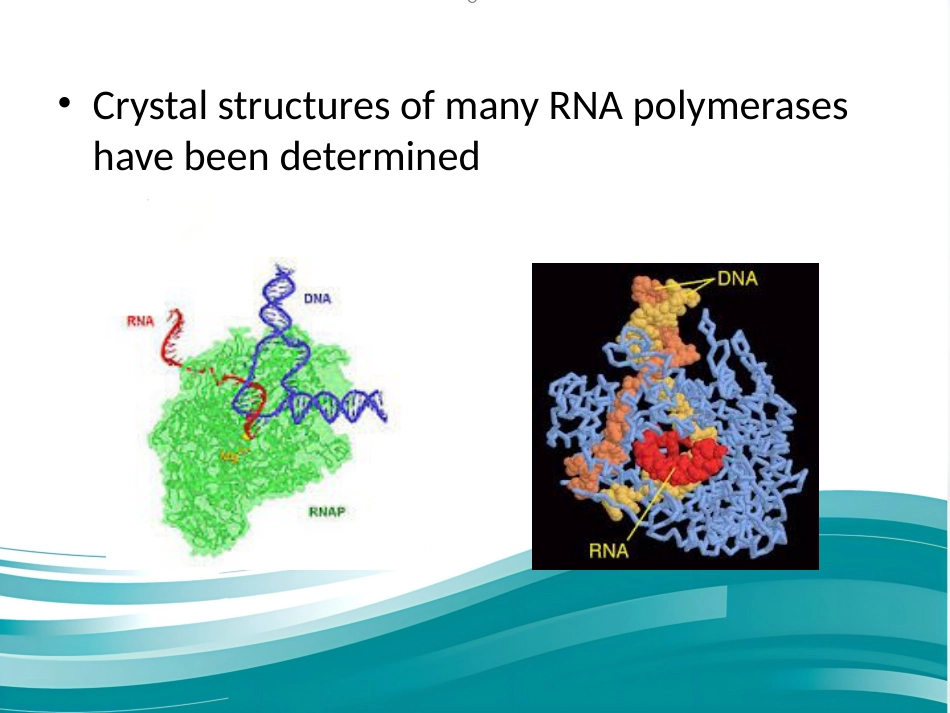
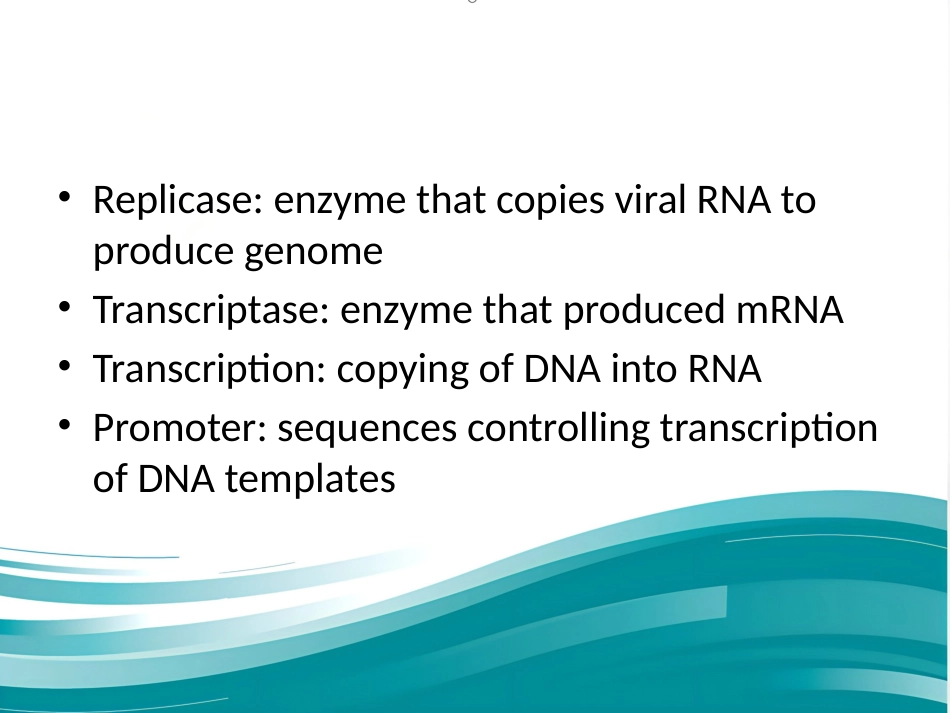
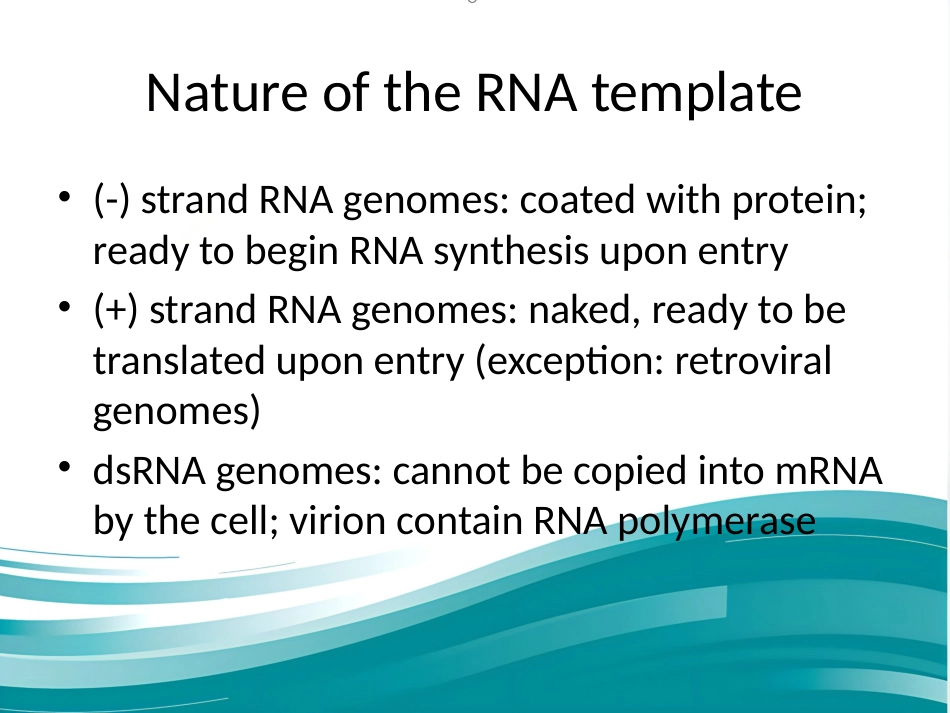
RNA SynthesisChang LiuSome history: RNA• 1935: Stanley crystallize TMV• 1936: TMV crystals contain 5% RNA• 1944: DNA is genetic material• 1952: Hershey-Chase experiment• 1953: Structure of DNA• 1956: TMV nucleic acid is infectious; first demonstration that RNA can be genetic material• By 1959, RNA was identified in many animal viruses• 1960s: studies on viral RNA replication begin• RNA genome must be copied end to end with no loss of nucleotide sequence• Production of viral mRNAs that can be efficiently translated by cellular protein synthetic machinery• Baltimore schemeRNA polymerase• RNA polymerase (RNAP or RNApol) is an enzyme that produces RNA. • In cells, RNAP is necessary for constructing RNA chains using DNA genes as templates, a process called transcription. • RNA polymerase enzymes are essential to life and are found in all organisms and many viruses. • Orthopoxviruses synthesize RNA using a virally encoded RNAP that is structurally and mechanistically related to bacterial RNAP, archaeal RNAP, and eukaryotic nuclear RNAP I-V. • Many viruses use a single-subunit DNA-dependent RNAP that is structurally and mechanistically related to the single-subunit RNAP of eukaryotic chloroplasts and mitochondria • Other viruses use a RNA-dependent RNAP (an RNAP that employs RNA as a template instead of DNA). – This occurs in negative strand RNA viruses and dsRNA viruses, both of which exist for a portion of their life cycle as double-stranded RNA. – However, some positive strand RNA viruses, such as poliovirus, also contain RNA-dependent RNAP.• Crystal structures of many RNA polymerases have been determined• Replicase: enzyme that copies viral RNA to produce genome• Transcriptase: enzyme that produced mRNA• Transcription: copying of DNA into RNA• Promoter: sequences controlling transcription of DNA templatesNature of the RNA template• (-) strand RNA genomes: coated with protein; ready to begin RNA synthesis upon entry• (+) strand RNA genomes: naked, ready to be translated upon entry (exception: retroviral genomes)• dsRNA genomes: cannot be copied into mRNA by the cell; virion contain RNA polymeraserhabdovirus vesicular stomatitis virus (VSV)Sendai virusUniversal rules for RNA-directed RNA synthesis• RNA synthesis initiates and terminates at specific sites on the template• RNAp may initiate synthesis de novo (like cellar DdRp) or require a primer• Other viral and cell proteins may be required• RNA is synthesized by template-directed stepwise incorporation of NTPs, elongated in 5’-3’ direction• No template RNA synthesisSequence relationship among polymerases• Gly-Asp-Asp in all (+) strand RNA polymerases• Asp-Asp in RT, segmented (-) strand polymerases• Gly-Asp-Asp in nonsegmented (-) strand polymerases; birnaviruses have Ala-Asp-Asn