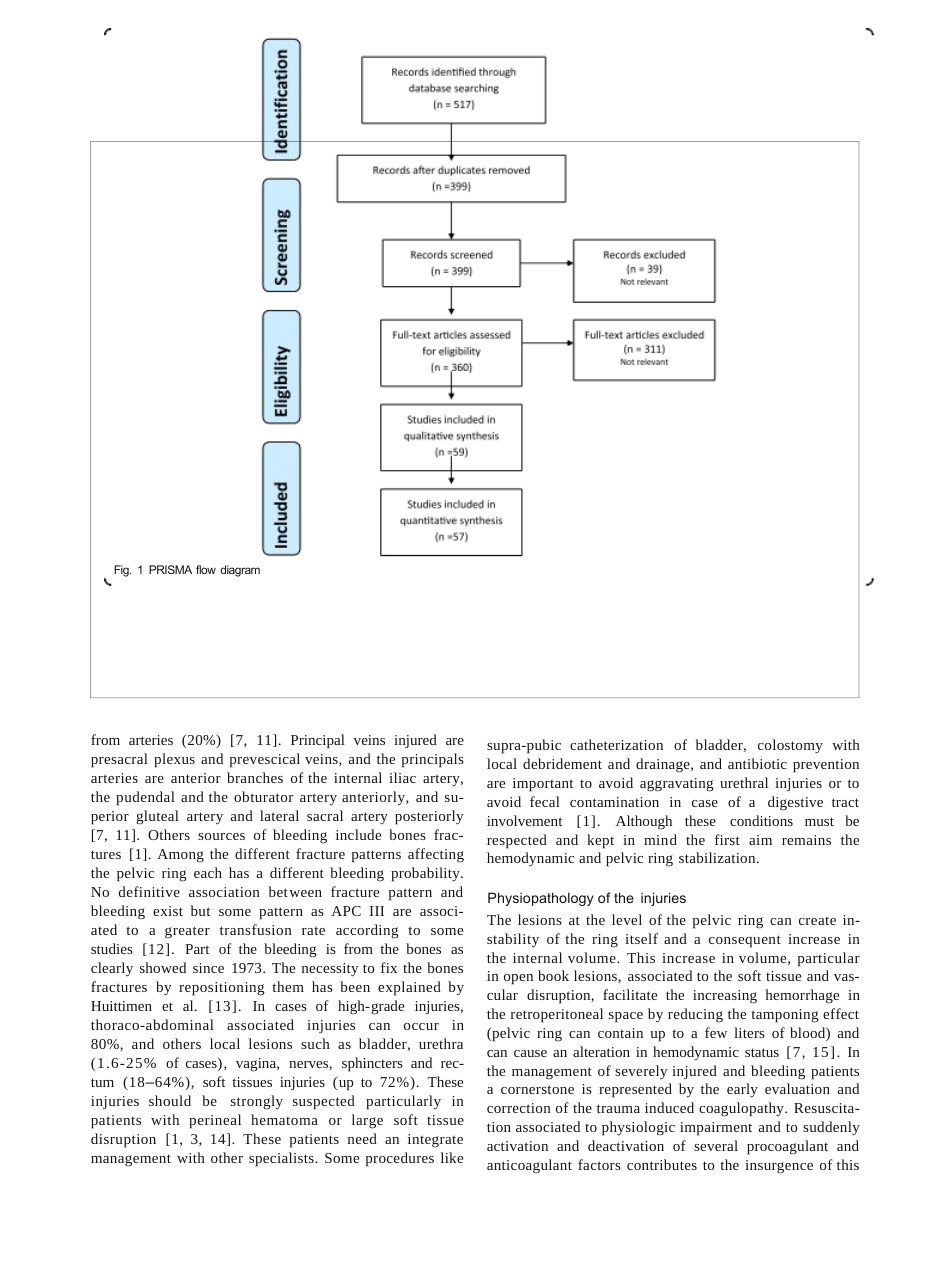
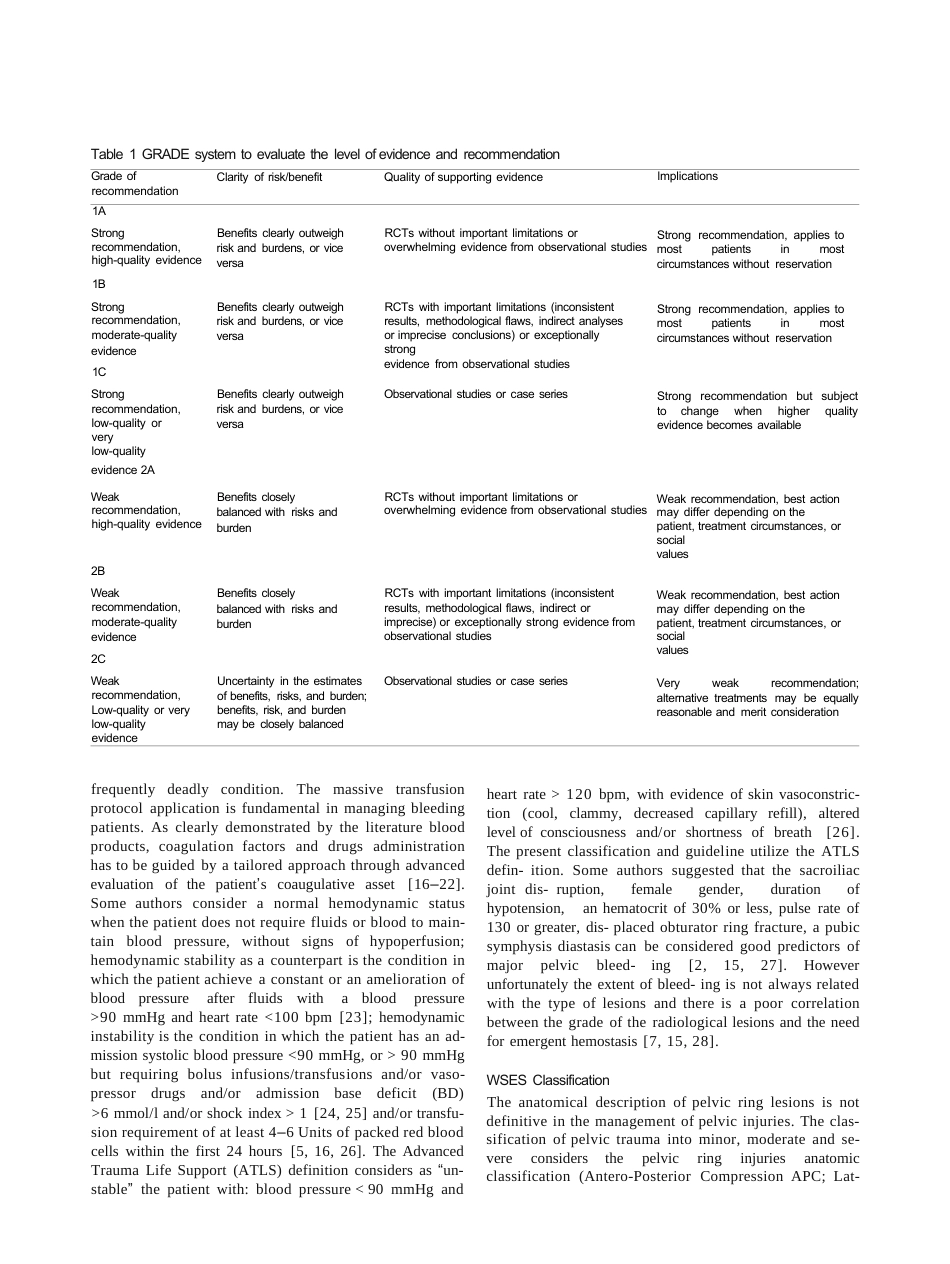
REVIEW Open Access Pelvic trauma: WSES classification and cr ·MarkguidelinesFederico Coccolini1*, Philip F. Stahel2, Giulia Montori1, Walter Biffl3, Tal M Horer4, Fausto Catena5, Yoram Kluger6, Ernest E. Moore7, Andrew B. Peitzman8, Rao Ivatury9, Raul Coimbra10, Gustavo Pereira Fraga11, Bruno Pereira11, Sandro Rizoli12, Andrew Kirkpatrick13, Ari Leppaniemi14, Roberto Manfredi1, Stefano Magnone1, Osvaldo Chiara15, Leonardo Solaini1, Marco Ceresoli1, Niccolò Allievi1, Catherine Arvieux16, George Velmahos17, Zsolt Balogh18,Noel Naidoo19, Dieter Weber20, Fikri Abu-Zidan21, Massimo Sartelli22 and Luca Ansaloni1AbstractComplex pelvic injuries are among the most dangerous and deadly trauma related lesions. Different classificationsystems exist, some are based on the mechanism of injury, some on anatomic patterns and some are focusingon the resulting instability requiring operative fixation. The optimal treatment strategy, however, should keepinto consideration the hemodynamic status, the anatomic impairment of pelvic ring function and the associatedinjuries. The management of pelvic trauma patients aims definitively to restore the homeostasis and the normalphysiopathology associated to the mechanical stability of the pelvic ring. Thus the management of pelvic trauma must be multidisciplinary and should be ultimately based on the physiology of the patient and the anatomy of the injury. This paper presents the World Society of Emergency Surgery (WSES) classification of pelvic trauma and the management Guidelines.Keywords: Pelvic, Trauma, Management, Guidelines, Mechanic, Injury, Angiography, REBOA, ABO, Preperitoneal pelvic packing, External fixation, Internal fixation, X-ray, Pelvic ring fracturesBackgroundPelvic trauma (PT) is one of the most complex manage- ment in trauma care and occurs in 3% of skeletal injur- ies [1–4]. Patients with pelvic fractures are usually young and they have a high overall injury severity score (ISS) (25 to 48 ISS) [3]. Mortality rates remain high, particularly in patients with hemodynamic instability, due to the rapid exsanguination, the difficulty to achieve hemostasis and the associated injuries [1, 2, 4, 5]. For these reasons, a multidisciplinary approach is crucial to manage the resuscitation, to control the bleeding and to manage bones injuries particularly in the first hours from trauma. PT patients should have an integrated manage- ment between trauma surgeons, orthopedic surgeons, interventional radiologists, anesthesiologists, ICU doctors and urologists 24/7 [6, 7].* Correspondence: federico.coccolini@gmail.com1General, Emergency and Trauma Surgery, Papa Giovanni XXIII Hospital, P.zza OMS 1, 24128 Bergamo, ItalyFull list of author information is available at the end of the articleAt present no comprehensive guidelines have been published about these issues. No correlation has been demonstrated to exist between type of pelvic ring ana- tomical lesion...